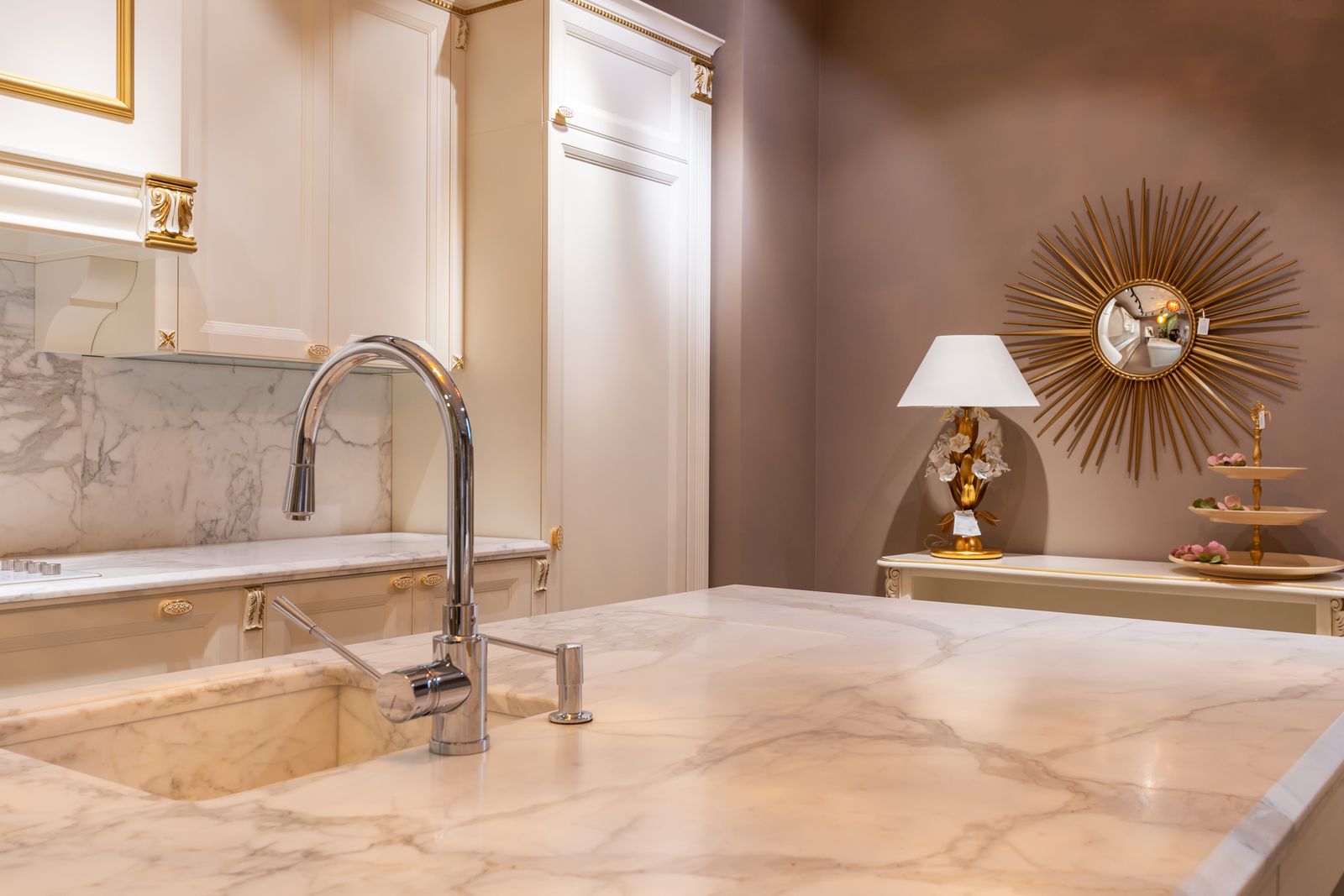
PART 05 — REFERENCE PHOTO: MARBLE BENCHTOPS, WHITE CABINETRY, ISLAND
PART 05 — NEOCLASSICAL
NEOCLASSICAL
KITCHENS.
Classic proportions with a lighter touch. Slim profiled fronts, a balanced elevation, a stone benchtop and fine metal hardware. Each one is made to measure for your room, built in our own workshop and backed by a 10-year warranty.
PART 05.1 — COMPONENTS
05
FOUR PARTS ON THE LIST.
01 FRONTS — SIMPLIFIED PROFILE
A neoclassical front keeps the frame-and-panel idea but pares it back to a narrow bevel or a single fine moulding in place of layered detail. We cut and profile every door and drawer in our own workshop, so the edge stays consistent across the whole kitchen.
02 SYMMETRY — BALANCED ELEVATION
The cooktop or sink sits on a centre line, with matching units on either side and tall cabinets at each end of the run. Because the kitchen is made to measure, unit widths are set to your wall, not to a stock module.
03 BENCHTOP — STONE
Stone gives the style its weight: a clean slab with a quiet edge, running the length of the kitchen or across an island. Against slim fronts, the benchtop becomes the strongest horizontal line in the room.
04 HARDWARE — FINE METAL
Small knobs and slim pulls in a finish that catches the light. The metal stays fine so it reads as detail rather than decoration, and it lines up with the symmetry of the fronts.
PART 05.2 — PAIRING
WOOD, STONE, METAL — IN THAT ORDER.
In a neoclassical kitchen, each of the three materials has a job. Timber or finished fronts set the proportion, stone adds weight and metal draws the final line. Handles go on last, and they are the easiest part to get wrong: too heavy and the kitchen turns classic, too minimal and it turns modern.
That is why we put samples of cabinet fronts, benchtops and hardware side by side before anything is cut. You see the combination as a set, not as three separate decisions.
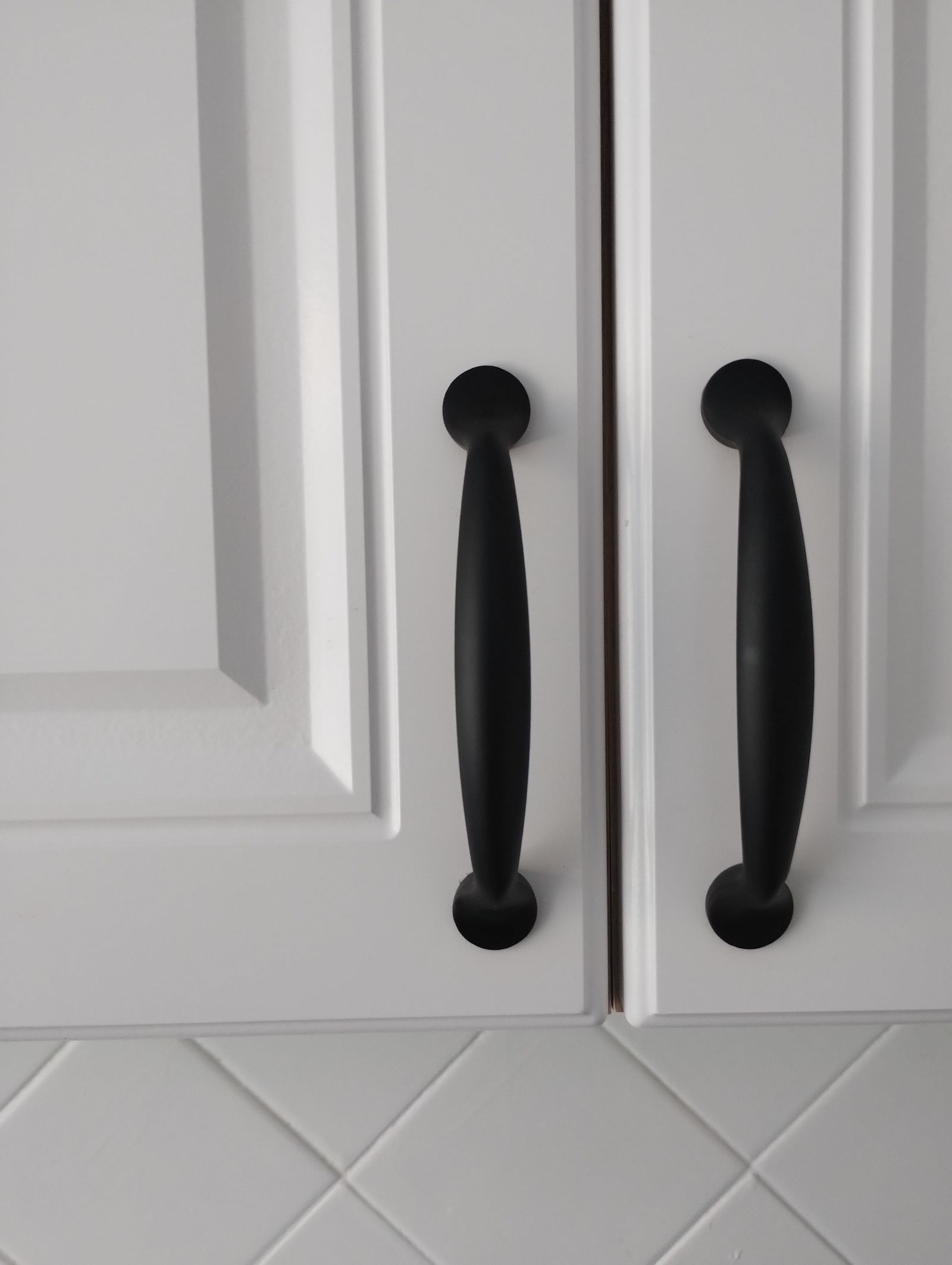
PART 05.2 — REFERENCE PHOTO: SLIM DARK HANDLES ON LIGHT PANELLED DOORS, THE LIGHTER MODERN DETAIL
PART 05.3 — DIFFERENCE
NEOCLASSICAL VS CLASSIC.
They share the same frame-and-panel logic. What differs is how much of it you can see.
FRONTS
CLASSIC Framed fronts with a deeper, more visible profile.
NEOCLASSICAL The same frame, drawn thinner and flatter.
ORNAMENT
CLASSIC Mouldings and detail are part of the character.
NEOCLASSICAL Ornament is pared back, and proportion does the work.
HARDWARE
CLASSIC Knobs, cups and pulls with real presence.
NEOCLASSICAL Finer pieces, lined up with the symmetry.
OVERALL READ
CLASSIC Traditional and warm.
NEOCLASSICAL Halfway between classic and modern, so it suits both period rooms and newer ones.
PART 05.4 — SETTING OUT
SYMMETRY STARTS WITH A TAPE MEASURE.
A balanced elevation only works when it is drawn to the real room: actual wall lengths, window positions and where the plumbing and power sit. That is why every neoclassical kitchen starts with a free measurement visit. The 3D design then shows the centre line and matching units before you approve anything.
Your estimate depends on layout, length, front material, benchtop and appliances. Neoclassical detail sits inside those same factors.
01 MEASUREMENT
02 3D DESIGN
03 APPROVAL
04 PRODUCTION — IN-HOUSE
05 DELIVERY
06 INSTALLATION
PART 05.5 — NEXT CUT
LAY IT OUT ON THE BOARD.
Start with the fronts, benchtops and hardware on the sample board, then have us measure the room so the symmetry is drawn to your walls.
Still deciding? Read Choosing a Kitchen Style for Your Home or compare with Modern Kitchens.